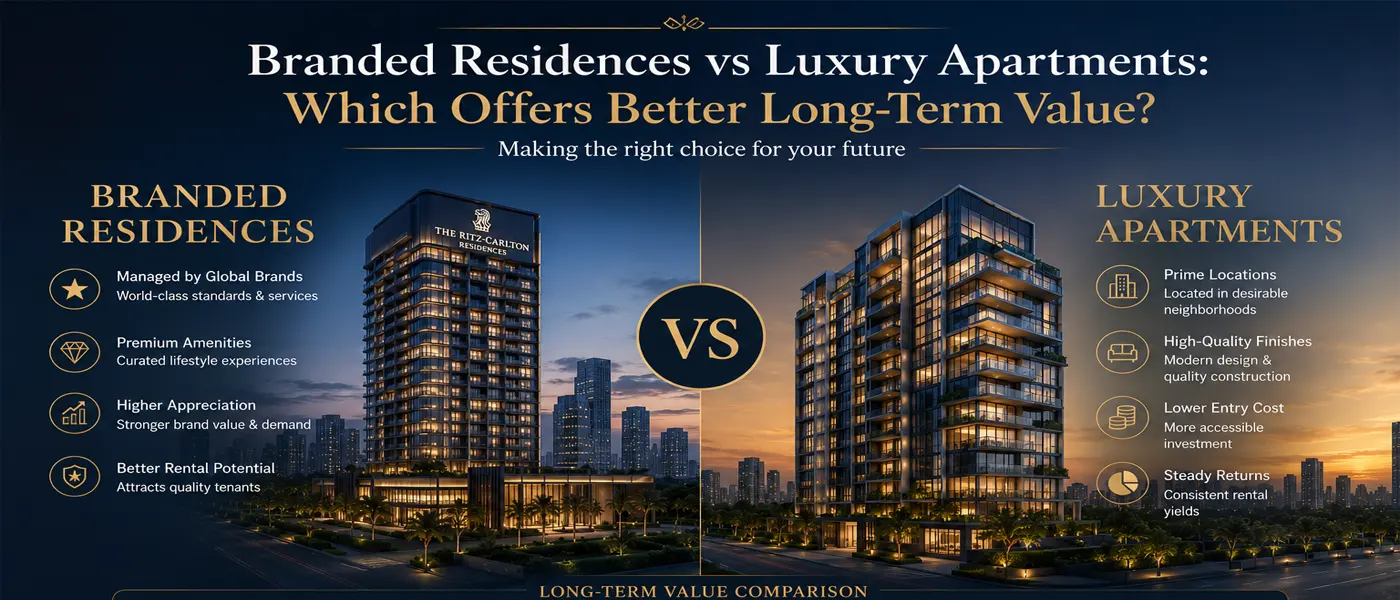
Branded Residences vs Traditional Luxury Apartments: Introduction
Luxury homebuyers today have more choices than ever before. Alongside premium residential projects developed by established real estate companies, branded residences have emerged as a distinct segment in the luxury housing market. These developments often combine high-quality construction with design expertise, hospitality-inspired services, or collaborations with globally recognised lifestyle brands.
As interest in luxury real estate continues to grow across cities like Gurgaon, Mumbai, Bengaluru, Hyderabad, and Dubai, many buyers wonder whether branded residences justify their premium pricing compared to traditional luxury apartments.
The answer depends on individual priorities, lifestyle preferences, and long-term investment goals. This article compares both property types to help buyers make an informed decision.
What Are Branded Residences?
Branded residences are premium homes associated with a recognised global brand through a formal collaboration with the developer. Depending on the project, the brand may contribute to architecture, interior design, hospitality services, lifestyle experiences, or property management.
These projects are generally positioned in the ultra-luxury segment and are designed to provide a differentiated living experience.
It is important to note that the level of brand involvement varies from one development to another, so buyers should always review the official project details.
What Are Traditional Luxury Apartments?
Traditional luxury apartments are premium residential developments built by reputed developers without an external lifestyle or hospitality brand association.
These projects often include:
- Spacious floor plans
- Clubhouses
- Swimming pools
- Landscaped gardens
- Smart home features
- Modern security systems
- Premium amenities
Many of India's leading developers have successfully delivered luxury communities that offer exceptional quality without being branded residences.
Branded Residences vs Traditional Luxury Apartments
| Feature | Branded Residences | Traditional Luxury Apartments |
|---|---|---|
| Brand Association | Yes, through an official collaboration | No external luxury brand |
| Design Philosophy | Often influenced by brand standards | Developer-led design |
| Lifestyle Experience | May include premium resident services | Depends on developer offerings |
| Exclusivity | Usually positioned as ultra-luxury | Varies by project |
| Pricing | Often commands a premium | Wide pricing range |
| Target Buyers | HNIs, UHNIs, global buyers | End-users and investors |
The table highlights general industry trends. Individual projects may differ based on developer vision, location, and specifications.
Lifestyle Experience
For many buyers, purchasing a luxury home is about more than square footage. Lifestyle has become an important consideration.
Branded residences may offer:
- Curated common spaces
- Premium concierge services
- Wellness-focused amenities
- Designer interiors
- Exclusive resident experiences
- International design standards
Traditional luxury apartments may also provide high-quality amenities, but the overall experience depends largely on the developer's design philosophy and management approach.
Investment Considerations
Property appreciation depends on several factors, not just branding.
Key aspects that influence long-term value include:
- Location
- Infrastructure development
- Developer reputation
- Construction quality
- Community planning
- Market demand
- Supply within the locality
While branded residences may attract premium buyers, a well-located traditional luxury apartment can also perform strongly over time.
There is no universal guarantee that one category will outperform the other.
Who Should Consider Branded Residences?
Branded residences may appeal to buyers who value:
- Exclusive lifestyle experiences
- International design collaborations
- Limited-density communities
- Premium resident services
- Distinctive architecture
These properties often attract buyers looking for uniqueness in addition to luxury.
Who Should Consider Traditional Luxury Apartments?
Traditional luxury developments may be suitable for buyers seeking:
- Premium living without paying a brand premium
- Larger inventory choices
- Flexible budgets
- Strong developer reputation
- Practical long-term residential use
Many established luxury projects offer world-class amenities and excellent living standards without an external brand association.
Questions Every Buyer Should Ask
Before purchasing any luxury property, buyers should evaluate:
- Is the project officially launched?
- Is the RERA registration available?
- What is the developer's delivery history?
- What amenities are actually included?
- How is the property managed after possession?
- Does the location have long-term growth potential?
- Are maintenance costs clearly explained?
These questions are relevant regardless of whether the project is branded or non-branded.
Common Misconceptions About Branded Residences
Myth: Every branded residence offers identical services.
Reality: Services and amenities vary depending on the collaboration agreement and project specifications.
Myth: Branded residences always deliver higher returns.
Reality: Property appreciation depends on multiple market factors, including location, demand, infrastructure, and overall economic conditions.
Myth: Traditional luxury apartments are inferior.
Reality: Many premium residential developments built by reputed developers offer exceptional quality, design, and long-term value without any external branding.
Conclusion
Both branded residences and traditional luxury apartments have their own advantages. Branded residences often appeal to buyers seeking exclusivity, curated lifestyle experiences, and internationally recognised collaborations. Traditional luxury apartments, on the other hand, can provide outstanding quality, premium amenities, and excellent long-term value without an external brand association.
Rather than choosing solely based on branding, buyers should evaluate the project's location, developer credibility, legal approvals, construction quality, and overall lifestyle offering. A well-informed decision based on verified information is likely to provide greater long-term satisfaction than focusing on branding alone.